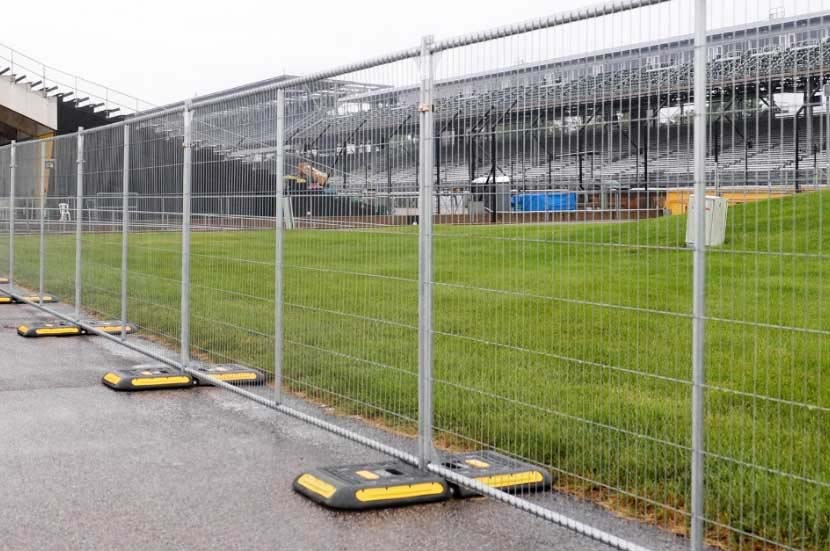
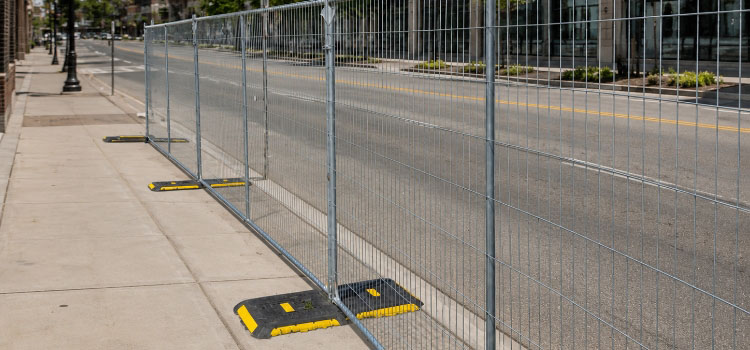
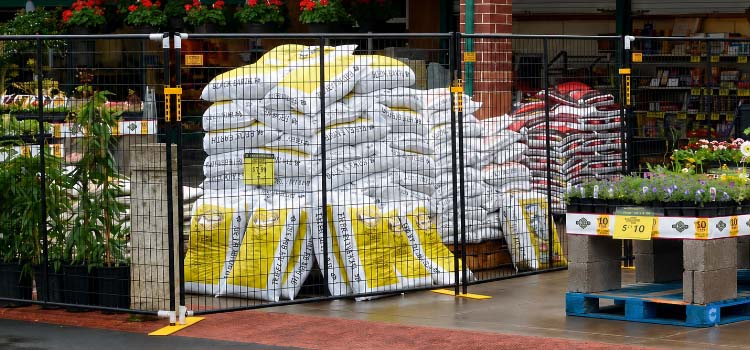
Welded wire panels offer a cleaner, more professional appearance than traditional chain-link fencing while providing secure temporary perimeters for construction sites, industrial facilities, storage yards, and controlled-access areas.
The welded mesh design produces smaller openings that make climbing more difficult, which is ideal for projects where the fence remains in place for extended periods.
Slick, professional-looking perimeter.
Reinforced corner plates and center vertical braces.
Available as individual panels or complete installation kits.
Smaller mesh openings discourage climbing.
Welded Mesh Panel Fence Specifications
Standard Welded Wire Fence Panels
Available in 6 ft x 12 ft and 8 ft x 12 ft, these pre-galvanized panels include reinforced corner plates and a vertical center brace for improved strength. Best suited for:
Construction sites
Utility projects
Equipment yards
Long-term temporary perimeters
Powder-Coated Welded Wire Fence Kits
Available in black or yellow, these 6 ft x 7.5 ft panels are well suited for applications where appearance, storage efficiency, and organized deployment are priorities. Best suited for:
Industrial facilities
Warehouses
Equipment storage
Events
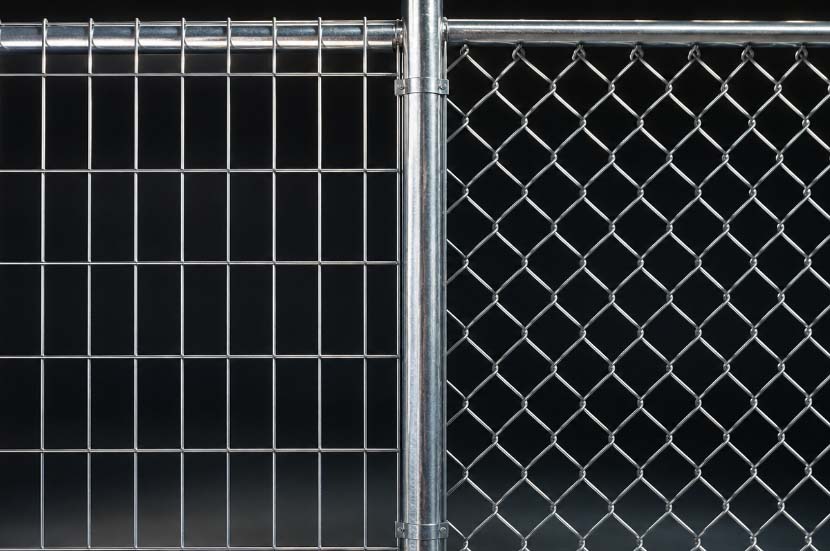
How Welded Wire Panels Differ from Chain Link
Both fence styles create secure temporary perimeters, but they're designed for different priorities. Choose welded wire fence panels when you need:
A cleaner, less industrial appearance, for public-facing areas.
Smaller openings for improved anti-climb performance.
A perimeter that will remain in place for an extended period with minimal repositioning.
If your project requires frequent transportation and repeated installations, chain-link fence panels are typically the better option. For projects where the fence will remain in place for an extended period and where appearance is just as important as security, welded wire fence panels offer a cleaner, more professional solution.
Welded Wire Fence Panel FAQs
1. When should I choose welded wire fence panels?
A: A type of temporary fence panel, welded wire fence panels are recommended when you want to create a secure perimeter for an extended period. The small mesh openings discourage climbing and they provide a professional-looking appearance.
2. What sizes are available?
A: SONCO offers pre-galvanized welded wire fence panels in 6 x 12 ft and 8 x 12 ft, along with 6 x 7.5 ft powder-coated panel kits.
3. Are welded wire fence panels available as complete kits?
A: Yes. Many welded wire fence panel options are available in kit form with compatible fence stands, clamps, and transport racks for faster deployment.
4. Can welded wire fence panels support privacy screens?
A: Yes. Welded wire fence panels are compatible with privacy screens when visual screening, branding, or dust control is required.
5. Can welded wire panels be moved or reused?
A: They can, but frequent transport and repositioning may reduce lifespan. Welded wire configurations perform best when movement is limited after initial installation.