






Traffic Delineators: Types, Uses, Spacing & How to Choose

SONCO, October 16, 2023
Read more about the author


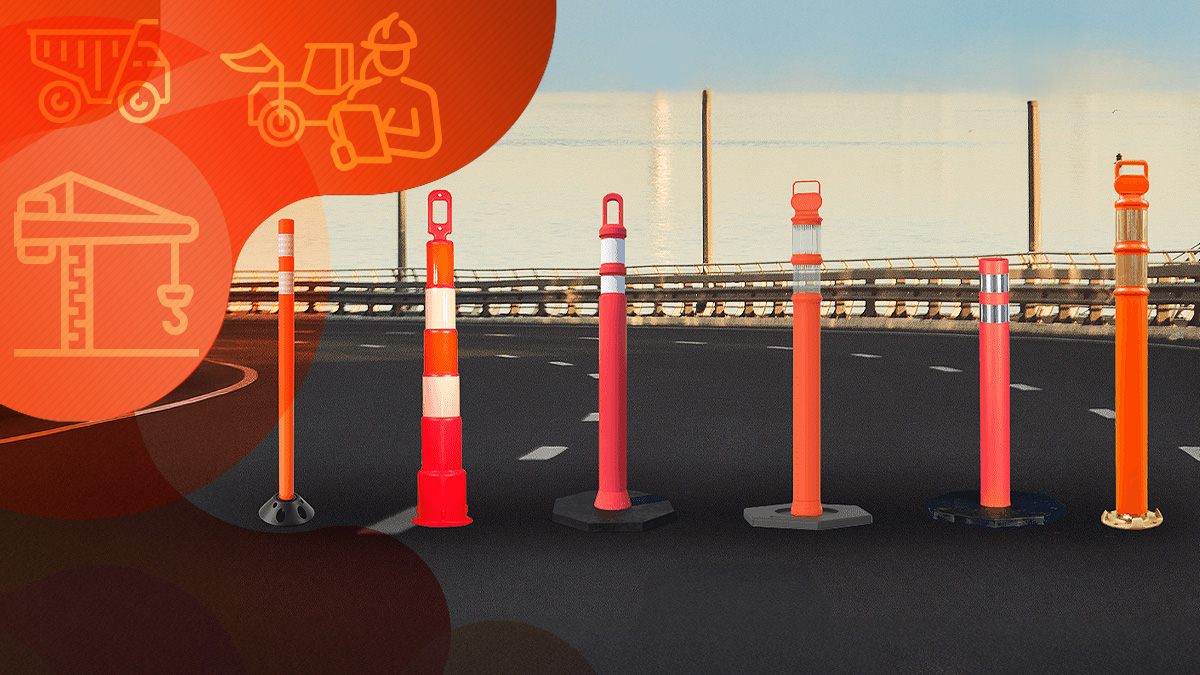
Traffic delineators are high-visibility posts used to guide drivers through areas where the roadway alignment isn't obvious, curves, lane shifts, tapers, and transitions. Unlike warning signs, they don't tell drivers about a hazard; they show drivers where to go.
The U.S. Federal Highway Administration classifies delineators as guidance devices, not warning devices.
As the Manual on Uniform Traffic Control Devices (MUTCD), Chapter 3F, explains:
Delineators are especially useful where the alignment might be confusing or unexpected, such as at lane-reduction transitions and curves, and they stay effective at night and in poor weather because they remain visible even when the road surface is wet or snow-covered.
This guide breaks down the two core delineator types (fixed and temporary), where each is used, how to choose between them, MUTCD spacing and placement rules, and how delineators compare to cones, barricades, channelizers, drums, and bollards.
Key Takeaways
- Delineators guide, they don't warn. FHWA classifies them as guidance devices that show drivers the correct path through curves, tapers, and transitions — a different job than warning signs or barricades.
- The choice between fixed and temporary comes down to duration and mobility. Fixed posts suit permanent or semi-permanent locations; temporary posts suit work zones, detours, and events where markers need to move.
- MUTCD sets the baseline for public roadways. Spacing, color, retroreflectivity, and placement all have national standards, generally 20–40 feet apart in work zone tapers, though private-property spacing is more flexible.
- They're a cost-effective alternative to signage and message boards: delivering clear, low-distraction guidance at a fraction of the cost of dynamic signs.
Are Traffic Delineators Guidance or Warning Devices?
Delineators are guidance devices. That distinction matters because it defines how and where they're used. A warning device (like a sign) alerts a driver to a hazard ahead — "curve ahead," "road work." A guidance device shows the driver the actual path to follow through that hazard in real time, post by post.
That's why delineators are most valuable exactly where lane markings alone fall short: sweeping curves, lane-reduction tapers, and any stretch where the road's edge or centerline isn't intuitively clear: especially at night or when the pavement is wet or snow-covered and paint markings lose contrast.

Types of Traffic Delineators
Traffic delineators come in several formats, each designed for a different installation method, traffic-control need, and level of portability.
The right choice depends on whether the post needs to stay fixed in place, move with changing work zones, fit into tight spaces, connect with chains or ropes, or rebound after vehicle contact.
Permanent Delineators
Permanent delineators are impact-resistant posts built for concrete or pavement surfaces. They typically use high-intensity reflective bands, reinforced bases, and mounting hardware to provide long-term lane guidance in locations where the traffic pattern stays consistent.
They’re the right fit where the goal is to guide traffic flow through road designs that are complex or easy to misread: think sweeping curves, parking structures, HOV lanes and turnpikes, and the entry/exit points of warehouses and commercial lots.
Portable Delineators
Portable delineators are designed for temporary installations where posts need to be deployed, moved, and stored quickly. They work well for outdoor events, parade routes, parking structures, school zones, event venues, and other short-term traffic-control setups.
Many portable styles can also be paired with optional chains or ropes to create a temporary delineator line for pedestrians, queues, parking areas, or controlled access points.
Slim Channelizer Posts
Slim channelizer posts are narrow, high-visibility posts built for small spaces where standard devices would take up too much room. They’re useful for tight parking areas, narrow streets, lane separation, and compact work zones, and can often support add-ons such as lights or signage for extra visibility.
Open-Top Delineators
Open-top delineators are economical, highly visible posts made from durable polyethylene and available with or without reflective bands. Their simple design makes them a practical choice for temporary traffic guidance, parking control, and general facility use.
Loop-Top Delineators
Loop-top delineators feature grab handles that make deployment, pickup, and repositioning easier for crews. Their slim profile works especially well on narrow streets, tight parking areas, and other locations where crews need fast setup without sacrificing visibility.
Flexible, Reboundable Delineator Posts
Flexible, reboundable delineator posts are heavy-duty posts designed to bend on impact and return upright after vehicle contact or drive-overs. Because they provide 360-degree visibility, they’re a strong option for high-contact areas that still need continuous guidance rather than a rigid barrier.
Fixed vs. Temporary Traffic Delineators
| Factor | Fixed Delineators | Temporary Delineators |
| Installation | Mounted directly to asphalt or concrete | Freestanding or base-mounted, no permanent anchoring |
| Typical duration | Mid- to long-term | Short-term, repositioned as needed |
| Portability | Low — built to stay in place | High — lightweight and stackable |
| Best for | Curves, parking structures, HOV lanes, commercial lot entries/exits | Work zones, detours, events, temporary/overflow parking |
| Impact response | Flexes and rebounds | Flexes and rebounds |
Where Are Traffic Delineators Used?
Road Construction and Work Zones
Temporary delineators mark safe paths through active construction and can be moved as the work progresses, keeping traffic clear of crews and equipment.
Lane Changes and Detours
When a route shifts temporarily, delineators give drivers a clear, continuous visual line to follow instead of relying on drivers to interpret faded or absent lane markings.
Curves and Roadway Transitions
This is where fixed delineators do their most important work — providing continuous guidance along bends and lane-reduction points where painted markings alone aren't enough, particularly at night or in poor weather.
Parking Lots and Garages
Posts separate incoming and outgoing traffic and mark lane boundaries in structures where visibility is naturally lower and turns are tighter.
Events and Temporary Traffic Management
Temporary delineators manage vehicle flow through parking areas and access roads for festivals, concerts, and other short-duration gatherings.
Commercial and Industrial Facilities
Fixed posts keep vehicle flow organized at the entry and exit points of warehouses, distribution centers, and business lots.
How to Choose the Right Traffic Delineator
1. Determine the Duration
If the application is long-term and the location won't change, a fixed post is the right call. If it's short-term — a work zone, a detour, an event — temporary is the better fit.
2. Consider Whether the Traffic Pattern Changes
Static traffic flow favors fixed delineators. If the pattern shifts as work progresses or conditions change, temporary posts that can be repositioned quickly make more sense.
3. Evaluate the Installation Surface
Fixed posts need a surface they can be mounted to — asphalt or concrete. Temporary posts work on a wider range of surfaces since they're freestanding or base-weighted rather than anchored.
4. Consider Visibility and Reflectivity
Look for recessed reflective banding and post height suited to the traffic speed and lighting conditions of the site — highway-adjacent applications need more visibility than a low-speed parking lot.
5. Consider Weather and Impact Exposure
Composite-polymer posts hold up to wind, rain, and snow, and rebound rather than break on vehicle contact — an important factor for high-traffic or high-risk locations.
6. Check Applicable Traffic-Control Requirements
Any application on or adjacent to a public roadway needs to meet MUTCD requirements for spacing, color, retroreflectivity, and placement. Private lots and facilities have more flexibility but should still follow the spacing and visibility principles below.
Traffic Delineator Spacing
Traffic delineator spacing depends on the speed of traffic, the shape of the roadway, the length of the run, and how much visual guidance drivers need to stay in the correct path. The goal is to create a clear, continuous line that drivers can read quickly: especially at night, in rain or snow, on curves, or anywhere lane markings may be hard to see.
As a general rule, use closer spacing where the driving path changes and wider spacing where the path is already obvious.
Curves, tapers, lane shifts, merge areas, work zones, and tight parking-lot layouts all need shorter gaps so the posts read as one continuous guide. Long, straight sections with good sight distance can use wider spacing because drivers already understand the roadway alignment.
For public roadways, always confirm the applicable MUTCD or local agency requirements before installation.
MUTCD guidance treats spacing as part of the overall roadway design: posts should be close enough that drivers can see the next few delineators ahead, and spacing may need to tighten through sharper curves or transitions.
For private facilities, there is more flexibility, but the same principle applies — if a driver could mistake the intended path, reduce the spacing.
| Application | Typical Spacing |
| Highway work zone tapers | Every 20–40 feet (MUTCD guidance) |
| Curves and transitions | Tighter spacing on sharper curves for continuous guidance |
| Parking lots and private facilities | Flexible, based on layout and visibility needs |
| Long, straight roadway segments | Wider spacing acceptable where alignment is already clear |
Traffic Delineators and MUTCD Requirements
Any delineator used on or adjacent to a public roadway in the U.S. needs to meet MUTCD standards, which cover four main areas:
Retroreflectivity
Delineators must remain visible at night and in headlight glare, which is why reflective banding is standard — SONCO's posts use three-inch recessed reflective bands designed to stay visible in the dark, in tunnels, and on wet or snow-covered roads.
Color
Orange and yellow are the standard colors for road and work-zone applications because they meet MUTCD high-visibility requirements. Other colors are available for parking lot or facility use, where standard roadway colors aren't required.
Placement
Placement rules account for the road's speed limit, lane configuration, and the specific hazard or transition being guided through — with tighter spacing generally required as speed and alignment complexity increase.
Roadway Applications
MUTCD-compliant delineators are what transportation departments, contractors, and construction companies rely on to meet FHWA standards without the cost of dynamic message boards or LED signage — delivering the same core guidance function at a fraction of the price.

Traffic Delineators vs. Other Traffic-Control Devices
Delineators vs. Cones
Cones are lightweight and meant for very short-term use — marking an accident scene or a brief lane closure. Delineator posts are taller, more durable, and built for extended use where they'll face repeated vehicle contact and weather exposure over time.
Delineators vs. Barricades
Barricades are physical barriers meant to close off a lane, road, or area entirely. Delineators don't block access — they guide traffic through an open path, making them the right choice when the goal is direction rather than closure.
Delineators vs. Channelizers
Channelizer is often used as the broader category that includes delineator posts, cones, and drums — devices that "channel" traffic along a defined path. Where delineators are typically slim posts used for continuous lane guidance, dedicated channelizers (often taller, around 42 inches) are geared toward funneling traffic through a taper or merge point with maximum visual target value.
Delineators vs. Drums
Drums are wider, heavier channelizing devices — generally around 36 inches tall with four alternating orange-and-white reflective bands — used as the primary device for lane closures, lane shifts, and shoulder or ramp closures on higher-speed roads. Delineators are slimmer and lighter, suited to continuous guidance rather than marking the edge of a closure.
Delineators vs. Bollards
Bollards are typically fixed, sturdier posts used more for access control and property protection than for guiding traffic flow — think blocking vehicle access to a walkway or storefront. Delineators are designed to flex and rebound on contact, since occasional vehicle contact is expected; bollards are generally rigid, since their job is to physically stop a vehicle rather than yield to one.
| Device | Primary Function | Typical Duration | Rebounds on Impact? |
| Delineator | Guide traffic through curves/transitions | Fixed or temporary | Yes |
| Cone | Mark short-term hazards or closures | Very short-term | Yes (lightweight) |
| Barricade | Block a lane, road, or area | Short- to mid-term | No |
| Channelizer | Funnel traffic through a taper/merge | Temporary | Yes |
| Drum | Mark lane/shoulder/ramp closures | Temporary | Yes |
| Bollard | Control access, protect property | Fixed/permanent | No |
Traffic Delineator Installation and Maintenance
Fixed Installation
Fixed posts are mounted directly to asphalt or concrete using anchor bolts or an adhesive base plate, depending on the model. The surface needs to be clean, dry, and structurally sound before mounting — installing on cracked or deteriorating pavement undermines the post's ability to flex and rebound as designed. Most fixed posts are installed once and left in place for the life of the application, with periodic checks rather than routine reinstallation.
Temporary Deployment
Temporary posts typically use a weighted or interlocking base rather than a permanent anchor, so they can be set and struck quickly as work zones, detours, or event footprints change. Because they're stackable, crews can transport a full run of posts in one trip and redeploy them as the traffic pattern shifts — the main trade-off for that flexibility is that base weight and surface contact matter more for stability, especially in wind or near passing traffic.
Inspection and Maintenance
Delineators should be checked regularly for:
- Reflective sheeting condition — bands that are faded, peeling, or dirty lose effectiveness fast, particularly at night.
- Post alignment — repeated vehicle contact can leave fixed posts leaning even after they rebound.
- Base and mounting integrity — loose anchors on fixed posts or underweighted bases on temporary posts are the most common causes of posts going missing or blowing over.
- UV and weather wear — composite-polymer posts resist fading, but color and flexibility should still be checked seasonally in high-exposure locations.
Frequently Asked Questions About Traffic Delineators
What is the difference between a traffic delineator and a traffic cone?
Cones are lightweight and meant for very short-term use, like marking an accident scene or a brief lane closure. Delineator posts are taller and more durable, built for extended use in work zones, parking areas, and roadway applications where they'll face repeated vehicle contact and weather exposure over time.
Are traffic delineators required to be MUTCD-compliant?
Yes, for any application on or adjacent to a public roadway in the U.S. The MUTCD sets the national standard for spacing, reflectivity, color, and placement. SONCO's delineator posts are MUTCD-approved for both fixed and temporary applications.
How far apart should traffic delineator posts be placed?
Spacing depends on road speed and application. In highway work zone tapers, MUTCD generally calls for posts every 20 to 40 feet. Parking lots and private facilities have more flexibility, based on layout and visibility needs.
Can traffic delineator posts be used indoors or in parking structures?
Yes. Fixed posts are commonly used in parking structures to separate lanes, guide vehicles through tight turns, and mark boundaries between pedestrian and vehicle areas — their impact-resistant, rebounding design suits confined spaces where contact is likely.
How do I choose between a fixed and a temporary delineator?
If the application is long-term and the location won't change, fixed is the right choice. If you need to reposition markers as conditions change, or the job is short-term — a work zone or event — temporary posts are the better, more versatile fit.
Shop SONCO Traffic Delineator Posts
The right delineator comes down to three questions: how long it needs to stay in place, how much the traffic pattern will change, and what visibility and compliance standards the location demands.
Fixed posts earn their keep in curves, structures, and high-volume corridors that don't change. Temporary posts earn theirs in work zones, detours, and events where flexibility matters more than permanence.
Fixed or temporary, SONCO builds delineator posts for real-world conditions — composite-polymer construction, recessed reflective banding, and MUTCD-approved compliance for both roadway and private-facility use. Trusted by contractors, transportation departments, and facility managers for 50 years.
Whichever you need, choosing a MUTCD-compliant, impact-resistant post is what keeps drivers moving safely — and keeps your site compliant.
Request a quote from SONCO to find the right delineator for your project.
Trend now

Temporary Fence Rental Lifespan: Tips to Make Your Fence Last Longer
Learn the storage habits that extend the lifespan of every panel.

How to Manage a Crowd at an Event: A Complete Guide for Event Managers
Learn how to manage a crowd at an event with proven strategies for planning, signage, barriers, staffing and more.

How to Install a Mesh Chain-Link Fence: Step-by-Step Guide
Learn how to install a mesh chain-link fence step by step.
Search for category
Request a quote now! 