






Temporary Fence Panels: Security Use

Giuliano Marinho, July 26, 2021
Read more about the author


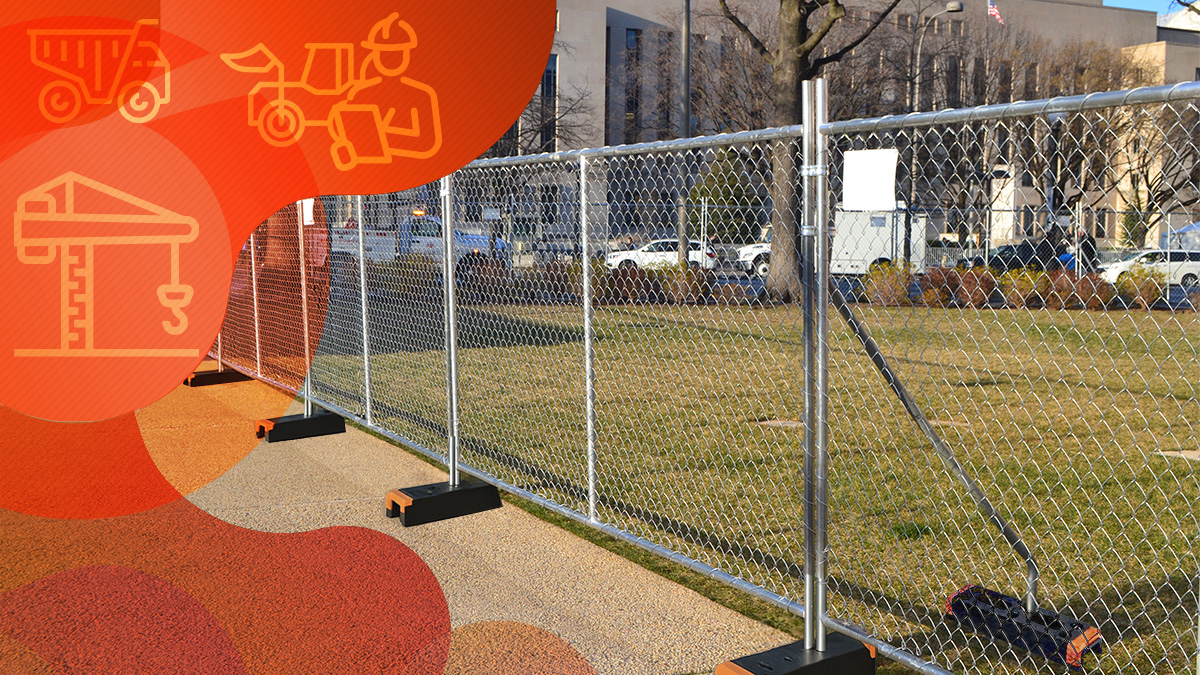
Temporary doesn't mean weak, if installed correctly. A temporary security fence can rival permanent solutions for most short-term needs. But set one up wrong, and it's little more than a visual suggestion.
This guide covers when temporary fencing is the right call, what actually makes it hold, and how to install it so it stays put, from base selection to add-on security options.
Key Takeaways
- Purpose-built bases like Anchor Blocks outperform sandbags and concrete blocks in stability and safety.
- Temporary fencing is the right choice for time-bound projects; permanent fencing is better for ongoing perimeters.
- Panel connectors, privacy screens, and fence toppers can significantly increase security without major cost.
- Standard panel sizes (6×10, 6×12, 8×10) cover most site configurations; custom sizes are available for complex layouts
When Temporary Fencing Is the Right Security Choice
Temporary fencing earns its place across a wide range of industries precisely because it's fast to deploy, easy to reconfigure, and inexpensive to replace. The most common applications include:
- Construction and demolition sites: controlling property entry, protecting pedestrians, and reducing liability
- Outdoor events and festivals: funneling crowds, managing queue lines, and defining clear venue boundaries
- Traffic and roadwork projects: separating workers from live lanes and guiding pedestrians safely
- Vandalism-prone sites: a physical barrier reduces graffiti and unauthorized access significantly
- Privacy-sensitive locations: screens mounted on panels protect equipment and
Temporary vs. Permanent: A Quick Decision Guide
| Situation | Best Choice |
| Construction site (weeks to months) | Temporary |
| Outdoor festival or public event | Temporary |
| Ongoing warehouse or facility perimeter | Permanent |
| High-security or anti-climb requirements | Permanent |
| Roadwork with changing layout | Temporary |
| School or campus long-term boundary | Permanent |
If your need is bounded by a project timeline or event window, temporary fencing is almost always the smarter, more cost-effective answer.
What Makes a Temporary Fence Actually Secure
Two things determine how secure a temporary fence really is: the panel quality and the base system. Most buyers focus on panels and underestimate bases, which is where most failures happen.
Panel Quality
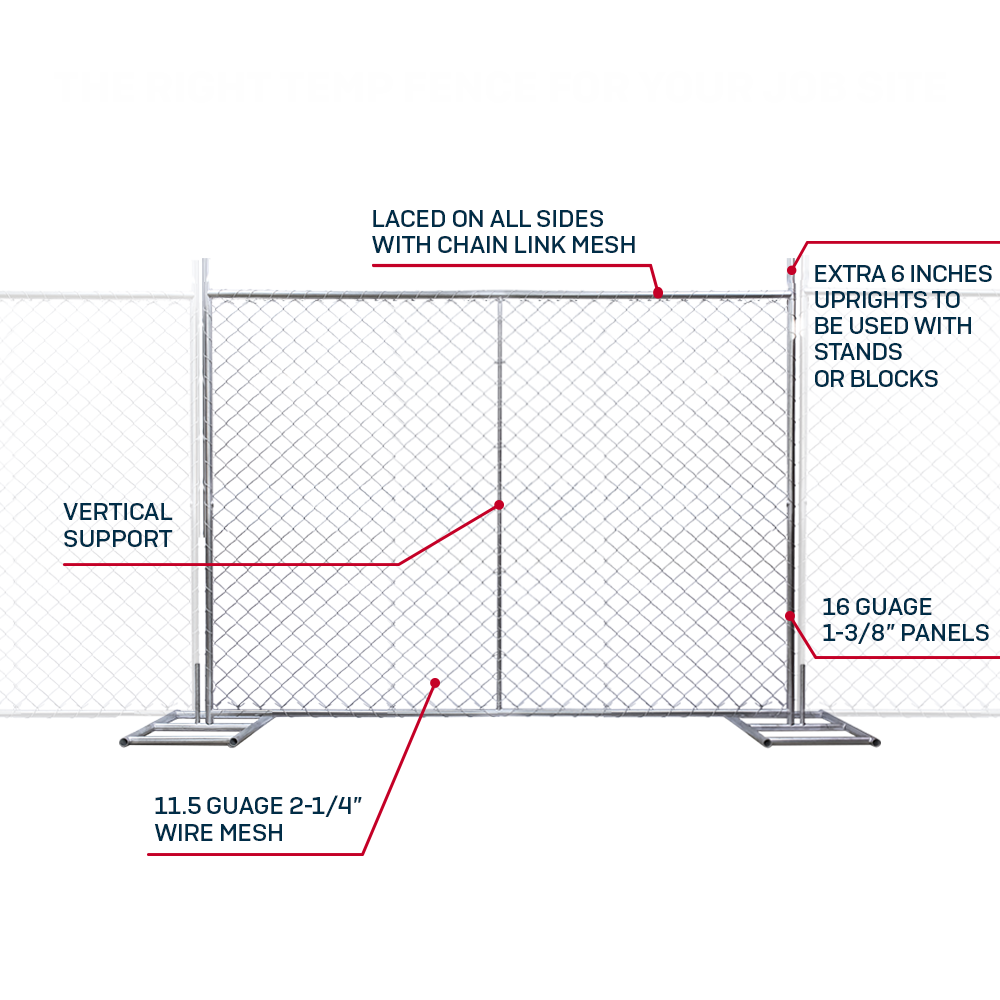
Look for chain-link panels built with:
- Heavy-gauge steel tubing on the frame (thicker = more rigid under lateral pressure)
- Extra cross-tube support mid-panel, which reduces flex and extends panel life in high-traffic areas.
- Galvanized or powder-coated finish for corrosion resistance, especially in outdoor or coastal environments
SONCO's chain-link panels are available in standard sizes (6×10, 6×12, and 8×10) as well as custom configurations and heavy-duty varieties — so there's a match for most project footprints.
The Real Weak Point: The Base
Even the strongest panel fails if it tips over. Wind, pedestrian pressure, uneven ground, and vehicle vibration all work against an unsupported panel. The base system is where security is won or lost, and it's the part most people get wrong.
How to Secure Temporary Fencing
1. Choose the Right Base for Your Ground Type
Not all surfaces are equal. Here's how to match your base to your conditions:
| Ground Type | Recommended Approach |
| Paved / concrete | Ballasted base (Anchor Block or similar) |
| Soft soil or grass | Rebar stakes driven through base feet |
| Mixed or unstable terrain | Heavy ballasted base + panel connectors |
| High wind exposure | Double-ballasted or weighted Anchor Bases system |
2. Ditch the Sandbags and Concrete Blocks
Many job sites still use sandbags or concrete blocks out of habit. They're cheap and familiar, but they underperform in almost every measurable way:
- Sandbags shift, degrade, and offer inconsistent weight distribution.
- Concrete blocks are heavy to move, create tripping hazards, and provide little lateral stability on their own.
- Neither is designed specifically for temporary fence geometry, which means fit is always approximate
4. Connect Panels Properly
Bases stabilize individual panels, but panel-to-panel connections prevent the fence line from spreading or gapping. Use fence couplers or clamps at every joint. For longer runs, add mid-span bracing where the fence changes direction or faces dominant wind.
5. Inspect After Installation
Walk the entire fence line after setup and check:
- Every base is fully seated and not rocking
- Panel connections are tight with no visible gap
- No panel leans more than a few degrees from vertical
- High-visibility inserts are facing outward toward pedestrian traffic
Extra Security Options to Layer On
Once your fence is stable, you can add targeted upgrades depending on your threat level.
Privacy Screens
Fence screens attach directly to chain-link panels and block sightlines into the site. They're especially useful for construction sites with valuable equipment, or events where you want to limit access without building a wall. SONCO offers custom-printed screens that can double as branded signage, keeping snooping down and marketing up at the same time.
Fence Toppers and Anti-Scale Options
For sites where climbing is a concern like festivals with paid access, secure infrastructure, or high-value equipment storage, fence toppers add a physical deterrent at the top of the panel. For the highest-security temporary needs, SONCO's anti-scale fence panels are purpose-built to resist climbing attempts entirely.
Custom Signage as Deterrence
Branded or warning signage mounted on fence panels reduces trespassing incidents by making the boundary feel official and monitored. "Authorized Personnel Only," "24-Hour Surveillance," or branded event perimeter signs all serve this function and add minimal cost.
Sizing and Configuration Guide
SONCO temporary fence panels are available in three standard sizes:
| Size | Best for |
| 6×10 ft | Tight urban sites, indoor venues, stairwells |
| 6×12 ft | Standard construction perimeters, events |
| 8×10 ft | Higher barriers where climb deterrence matters |
Ready to Secure Your Site?
SONCO has 45+ years of expertise in temporary perimeter security. Whether you're fencing a construction site, an outdoor event, or a roadwork project, our team can recommend the right panel, base, and accessory combination for your exact conditions.
Frequently Asked Questions
How do I keep a temporary fence from falling over?
The most reliable solution is a purpose-built ballasted base like SONCO's OxBlock or OxStand. These are specifically designed for the geometry of chain-link panels and outperform sandbags or concrete blocks in stability, safety, and ease of use.
Do I need a permit for a temporary security fence?
It depends on your municipality and the fence's location. Fences along public sidewalks or roads often require a permit, while those entirely on private property typically don't. Check with your local building or public works department before installation.
What's the difference between a chain-link panel and an anti-scale fence?
Standard chain-link panels provide a physical perimeter barrier and are appropriate for most construction, event, and traffic applications. Anti-scale panels are engineered with climbing-resistant geometry — fewer footholds, reinforced mesh — and are used when the risk of someone deliberately climbing over is a real concern.
How many panels do I need?
Measure your total perimeter in feet and divide by your panel width (10 or 12 ft). Add 10–15% for gates, corners, and overlaps. SONCO's team can help you spec an exact count from a site plan or perimeter sketch.
Trend now

Temporary Fence Rental Lifespan: Tips to Make Your Fence Last Longer
Learn the storage habits that extend the lifespan of every panel.

How to Manage a Crowd at an Event: A Complete Guide for Event Managers
Learn how to manage a crowd at an event with proven strategies for planning, signage, barriers, staffing and more.

How to Install a Mesh Chain-Link Fence: Step-by-Step Guide
Learn how to install a mesh chain-link fence step by step.
Search for category
Request a quote now! 